
Common Reasons Research Proposals Get Rejected and How to Avoid Them
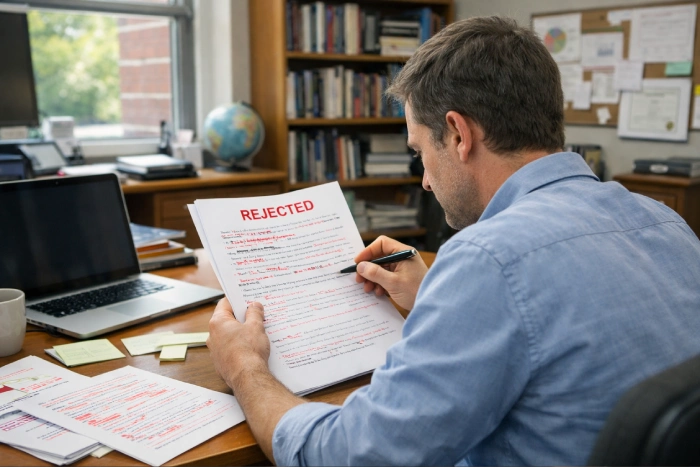
Just because a research proposal is rejected, it does not mean that the research idea is too weak. Often, it is not even possible for reviewers to envision how the proposed study can be realised. This is why research proposals get rejected in spite of the academic value of the research topic. A research proposal that is rejected typically has issues related to feasibility, clarity or evidence. This guide will help you understand the 6 popular reasons why problems occur and how to correct them. If you need assistance with writing your dissertation’s conceptual framework, see our resources on how to write a conceptual framework for your dissertation.
What a Reviewer Is Actually Checking
Typically, reviewers will evaluate four aspects when deciding for a proposal approve. The issue is whether there is a problem to be researched, or if it is just an interesting topic. Second, does the suggested approach provide a solution to the research question? Third, are there enough time, access, skills and resources available for the researcher to complete the study? Lastly, does the study ethically and practically lend itself to the study?
All the reasons listed below are related to one of these concerns. The research proposal rejected is usually a sign that the research is not likely to be able to provide a defensible answer. Having an understanding of this perspective will help the research proposal feedback be understood more easily.
Reason 1 — There’s No Clear Research Problem
The failure: The discussion is on a general topic, but not a problem. The area of study that is suggested is not a research question but a description of an area of study.
What the reviewer sees: If there is no question in the study, then the reviewers won’t know what the study is looking to find.
The fix: State the problem, research gap and question close to the beginning. Next, link your goal to 3-4 measurable goals.
An often-made research proposal mistake is confusing aims and objectives. They perform various functions. Understand how to write a research proposal, and try out the opening with somebody who isn’t in your field. They should make sure that they know what you need to look into.
Reason 2 — The Methodology Doesn’t Match the Question
The failure: A researcher asks questions about the reasons why people act differently and suggests a survey only. Another question about prevalence, but schedules 6 interviews.
What the reviewer sees: The selection of the method seems to be arbitrary rather than a result of research.
The fix: Begin by writing the research question. Then, explain the research design, sampling strategy, method of data collection, and analysis method.
This is one of the most serious research proposal mistakes, as a good question can’t compensate for a bad method. If a research paper is rejected for methodological reasons, then it will require more than a rewrite in terms of the language. Give reason(s) why your selected method can yield evidence which addresses your question. Employ logic in the explanation of how to choose the right research methodology.
Reason 3 — The Scope Is Unrealistic
The Failure: Hundreds of participants required for the project, several countries or large amounts of field work within a short programme.
What the reviewer sees: The researcher may run out of time and/or have an impact on the study.
The fix: Make the population, location, time or number of variables more limited. A well-thought-out study, rather than a large-scale project with not much done, may yield greater evidence.
If you can’t plan to gather data every week, then rethink the scope of your data. If a research proposal is rejected due to impractical research plans, then careful narrowing might make it a viable option for proposal approval.
Reason 4 — The Literature Is Thin or Outdated
The failure: The literature review does not include a comparison of sources. It could equally be based on outdated research in a very dynamic area of study.
Whatthe reviewer sees: The researcher may not recognise the debate that is going on, or may not be aware whether this question has been answered or not.
The fix: Structure literature based on themes, disagreements and key findings. Demonstrate agreement and disagreement of researchers. You should eventually be able to determine what gap your study will fill in your review.
Another common research proposal mistakes are to conclude the research gap instead of a summary. Good guidance on how to write a research proposal should always emphasise synthesis, not simple source description.
Reason 5 — Ethics and Feasibility Gaps
The failure: little attempt is made to address consent, confidentiality, participant vulnerability and data storage in the proposal. May also take access to participants/organisations without verification.
What the reviewer sees: The study might not get ethical clearance, or it may be impossible to carry out.
The fix: Discuss consent procedures, confidentiality measures, how it will be stored, how it can be withdrawn, and participant protection. Check organisation access or dataset before submission, if possible.
If a research proposal is rejected due to a lack of ethics planning, it needs to be substantially revised. These practical issues can be emphasised when giving research proposal feedback with a good idea, as they can impact the participants and the validity of the research.
Reason 6 — Presentation and Compliance Failures
The Failure: The proposal does not follow the department’s template, is too long or does not cite consistently or include missing sections.
What the reviewer sees: The submission requirements have not been met.
The fix: Review the department’s current brief before sending. Check the structure, references, ethics statement, timeline and budget (where applicable) and deadline.
These are the research proposal mistakes, and can be frustrating as they can make the reviewers not consider the research idea before giving it a chance for proposal approval.
Pre-Submission Checklist
Before submission, review the following:
- Are the research question(s) clearly expressed?
- Does the method clearly address the question?
- Is the timeline suitable for the programme?
- Does the participant have access to the data, or has data access been confirmed?
- Is there an identified gap in the literature?
- Are ethics and data storage covered?
- Have you used the department’s form?
- Has anyone (not inside your field) read the proposal?
This checklist helps understand how to write a research proposal, which can be quickly reviewed by your research committee. Research proposal feedback before submitting it will also help to identify unclear parts of the proposal.
Frequently Asked Questions
- Why do research proposals get rejected?
Why research proposals get rejecteddue to poor problem formulation, inappropriate research techniques, insufficient scope, poor literature and/or ethics issues, and failure to meet ethical compliance.
- Can I resubmit a rejected research proposal?
Yes. If a research proposal is rejected by one committee, it can be accepted when it is modified to resolve the concerns of the committee members.
- How long should a research proposal be?
There’s no fixed length. Adhere to the word limit requirements set by your university, department, programme and/or supervisor.
- What is the most common reason for rejection?
Study feasibility is frequently an issue when research questions are unclear and/or the methodology is not matched.
- How do I respond to reviewer feedback?
Make comments on each of the points, outline the changes you have made, and explain why you have not made a recommendation if you have not.
Conclusion + CTA
Knowing why research proposals get rejected enables you to correct any feasibility issues before submitting them. Read through your proposal, respond to comments, and enhance the supporting evidence for your research plan.