
How to Create a Research Timeline for a Master’s or PhD Dissertation
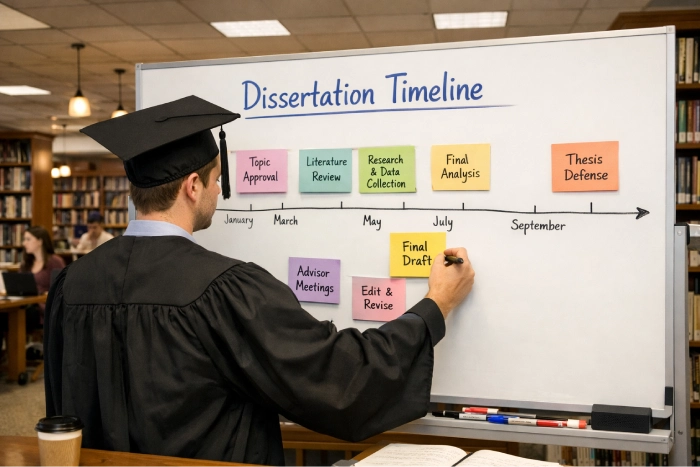
A research timeline helps break your dissertation into phases with realistic duration and dependencies. It is built backwards from the submission deadline and is not a generic template that does not fit your specific dissertation and time needs. Many timelines fail because students underestimate the approval-dependent phases that can take extra time, such as ethics and data access, which they cannot fully control. In this guide, we will explain how to create a research timeline for dissertation projects.
What a Research Timeline Actually Needs to Show
Your dissertation timeline is not there for decorative purposes. Supervisors and review committees may also check whether it is realistic. You can’t just write a flat list of phases. You need a dependency-based timeline, which means some tasks cannot start until others are finished. For example, data collection cannot begin until you receive ethics approval.
Your timeline must include:
- Every major phase from topic refinement to final submission
- Realistic start and end dates or durations for each phase
- Dependencies showing which tasks must finish before others begin
- Built-in buffer time for feedback cycles, revisions, and delays
- Supervisor review or milestone check-in points
A lot of students don’t realize that an unrealistic timeline can weaken their research proposal. Understanding why research proposals get rejected can help you avoid this mistake.
Master’s Dissertation Timeline vs PhD Timeline: Why They’re Different
The Master’s dissertation timeline weeks can look very different from a PhD timeline.
Master’s dissertation (typical):
- Topic and proposal: weeks 1–2
- Literature review: weeks 3–6
- Methodology and ethics: weeks 5–7
- Data collection: weeks 7–10
- Analysis and writing: weeks 10–16
- Revisions and submission: weeks 16–20
PhD dissertation (typical):
- Coursework and supervisor selection: year 1
- Proposal development and defence: years 1–2
- Ethics approval and pilot study: year 2
- Main data collection: years 2–3
- Analysis and writing: years 3–4
- Final writing and defence: final year
A PhD research timeline template includes milestone gates such as proposal defence, candidacy, and dissertation defence as fixed points. A Master’s timeline is tight enough that even a two-week delay can threaten the entire schedule. If you are approaching your final milestone, then learn how to prepare for your thesis viva or dissertation defence.
Step-by-Step: Build Your Timeline Backwards From Your Submission Date
If you are wondering how to create a research timeline for a dissertation, then you should use a framework that helps you build a realistic schedule. Instead of listing phases forward, you need to work backwards from your fixed submission deadline.
Step 1: Start with your fixed submission date.
Step 2: List every mandatory milestone from your programme handbook—proposal approval, ethics approval, progress reviews, and viva or defence. Do not rely on memory.
Step 3: Estimate how long each phase will take. Start with tasks you can do now and work backwards from the deadline for later tasks.
Step 4: You need to identify which phases must be completed before the next phase can begin, such as completing ethics approval before starting data collection.
Step 5: Add 15–20% buffer time to every major phase, especially literature review and supervisor feedback cycles.
Step 6: Mark fixed supervisor review or committee check-in points on your timeline.
Step 7: Put the final version into a visual tool such as a spreadsheet, dissertation Gantt chart, or planning app and revisit it monthly.
Knowing how to write a strong research gap will help to strengthen your proposal.
Realistic Time Estimates for Each Dissertation Phase
How long does a PhD dissertation take? The answer varies widely depending on the research topic, methodology, data collection, and revision process.
| Dissertation Phase | Realistic Time Estimate |
| Initial literature search and topic scoping | 3–8 weeks, depending on your field and level of prior knowledge |
| Literature review writing and synthesis | 8–12 weeks, often longer for PhD-level reviews |
| Ethics application, submission, and approval | 4–8 weeks, but this varies by institution |
| Pilot study (if applicable) | 4–6 weeks |
| Main data collection | Highly variable — weeks for a small survey and months for interviews or longitudinal studies |
| Transcription (if interviews are used) | Around 4 hours of transcription per 1 hour of recording |
| Data analysis | 4–10 weeks, depending on the method, such as statistical analysis or thematic coding |
| Writing, supervisor feedback, and revisions | 6–12 weeks, and often the most underestimated phase |
You must select the right methodology in order to ensure that you don’t have to redo the whole research again because of a methodology mismatch. Read how to choose the right research methodology for your project.
UAE-Specific Timeline Risks Students Often Miss
When creating a thesis timeline UAE university students should also consider factors beyond research and writing. They need to account for extra time for university procedures, approvals, and holidays. Planning for these factors early can help prevent any unexpected delays.
- Ethics approval: University or hospital ethics approval may take longer than expected, so check the usual processing time early.
- Research permissions: Research in schools, companies, or government organisations may require additional approval, which can take weeks or months.
- Ramadan and holidays: Recruitment, data collection, and supervisor feedback may take longer during Ramadan and major holidays.
- English-Arabic research: Using both English and Arabic may require extra time for translation and back-translation before approval.
- Supervisor feedback: Supervisors may take longer to respond during exams, semester breaks, or holidays, so allow extra time for feedback and revisions.
Common Timeline Mistakes That Delay Graduation
These are the most common timeline mistakes that should be avoided at all costs.
- Underestimating the amount of time it will take to write the literature review.
- Building a timeline without allowing extra time for feedback or revisions.
- Assuming tasks can run in parallel when one must be completed before another can begin.
- Planning data collection to start before ethics or gatekeeper approval is fully confirmed in writing
- Not updating the timeline once real delays happen, so it stops being a useful planning tool.
Tools You Can Use to Build Your Timeline
In order for your dissertation planning schedule to work, you need to choose a tool that supports your workflow and the one you will actually use consistently.
- Spreadsheet tools (Excel, Google Sheets): Flexible and easy to share.
- Word table or simple list: Sufficient for shorter Master’s timelines.
- Dedicated Gantt chart tools: Useful for PhD-length timelines.
- Project boards (Notion, Trello): Track weekly tasks alongside the bigger picture.
Frequently Asked Questions
How long should a Master’s dissertation timeline be?
Most Master’s dissertation timelines take around 12–20 weeks from proposal approval to final submission. However, the exact time depends on your university and whether you study full-time or part-time. Always check your programme handbook for the official timeline.
How long should a PhD research timeline be?
A PhD research timeline usually covers around 3 to 6 years. The exact length of the dissertation depends on your country, funding structure, and whether you are studying full-time or part-time. Your timeline should also have fixed milestones such as candidacy, proposal defence, and final dissertation defence.
What is the biggest cause of dissertation timeline delays?
One of the biggest causes of timeline delays is underestimating approval-dependent phases such as ethics approval, gatekeeper access, and supervisor feedback. These phases are largely outside your control, so it is important to allow extra buffer time for them.
Should I build my timeline forwards or backwards from my deadline?
Backwards planning is more efficient and reliable. You need to start from your fixed submission date and place mandatory milestones on the calendar. Then you need to work backwards to see how much time each phase has left.
How much buffer time should I add to a dissertation timeline?
You should add 15-20% extra time to major dissertation phases. This will give you room for delays in research, data collection, supervisor feedback, and revisions without disrupting your overall timeline.
Need Help Building Your Research Timeline?
Even a well-built dissertation timeline needs adjusting once you start the real work. But it is important to note that this is normal. If you need support for building a realistic project plan or executing specific phases of it, then you can explore our dissertation writing services and thesis writing services. You can also contact us if you want to speak with an advisor about your timeline.